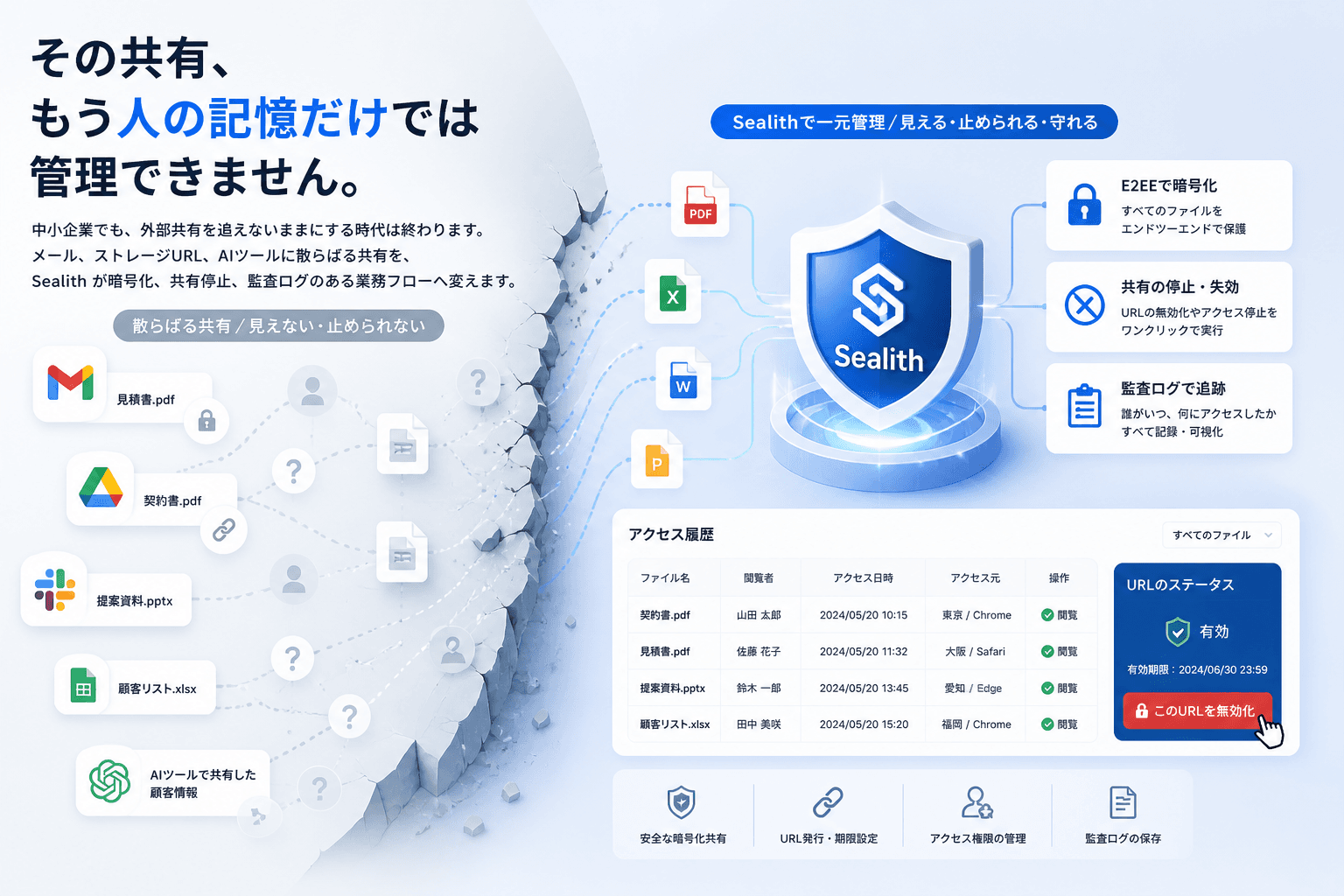
That sharing cannot be managed with human memory alone anymore
Why now
This is not only an enterprise problem
01
This used to be tolerable
Smaller companies could postpone fine-grained sharing control and still keep work moving.
02
But sharing got more complex
Email, chat, storage URLs, and AI tools now mix together, making it harder to trace what left the company.
03
AI pushes beyond human tracking limits
Soon not only people but also AI will pass materials around. Untracked sharing becomes a high-risk default.
04
So route sharing through one place
Sealith turns sending, receiving, URL sharing, revoke, and audit logs into one operating flow.
AI pressure
AI will sharply increase how much sharing a company must manage
External sharing decisions per person
Before → With AI
Number of sharing paths
Mostly email → Email / URL / AI / workflows
Difficulty of accountability
Still traceable by memory → No longer traceable by memory
Leak paths multiply too
Why old ways fail
Being able to send is not the same as being able to govern
Typical file transfer
You can send files, but open tracking, resend, revoke, and organization-wide auditability are weak.
Typical storage sharing
Link sharing is easy, but it remains hard to explain later who received the link and how it spread.
Direct upload to AI tools
Convenient, but business logs rarely capture which AI received which material for what purpose.
Why Sealith
Sealith turns sharing itself into an operating workflow
Do not leave file bodies in plaintext on the server
Files are encrypted in the browser before upload, so Sealith handles encrypted payloads only.
Deliver URLs with auditability
Drive and Box links can also be routed through Sealith so access flow and delivery history remain visible.
Handle revoke inside the same flow
Expiry, count limits, and manual revoke are managed in the same operating path as sending.
Track people and AI under one audit standard
On Business and above, Agent Token and MCP make AI actions visible with purpose and tokenId context.
Send
Register an encrypted file or shared URL
Deliver
Separate the URL and passcode when sharing
Track
Record receipt, external link visits, and AI actions
Stop
Stop receipt by expiry, count, or manual revoke
Use cases
Look beyond people-only sharing to AI-involved handoff too
Person → Person
Share contracts, invoices, and personal-data materials in a way that remains traceable later.
Person → AI
When handing off to AI for review or matching, record the purpose and tokenId as part of the delivery trail.
AI → AI
On Business and above, MCP and API allow even AI-to-AI handoff to move toward an explainable operating model.
Rollout
Do not aim for perfect control on day one. Start by routing sharing through one place
Phase 1
Move sharing into Sealith first
Replace attachment delivery with encrypted transfer and turn storage URLs into audited URL sharing.
Phase 2
Make it the team rule
Use Starter for receipt checks and CSV export, and Business for multiple admins, to standardize external sharing.
Phase 3
Expand into AI and higher-order governance
Use Business to bring AI send and AI receive into the same audit ledger through API and MCP.
Google Workspace roadmap
Google Workspace integration is a strong next move
What you can do now
Convert URL sharing with the Chrome extension
Turn the current page URL, clipboard URL, or a manually entered URL into audited Sealith URL delivery, including light banners around Gmail and Drive.
What to expand next
Natural Gmail and Drive handoff
Pre-fill recipients and subjects from Gmail, or create Sealith delivery directly from Drive links, to make Workspace usage feel more native.
Admin-facing extension
Workspace integration and visibility into off-path sharing
Later phases can surface external shares that bypass Sealith and help organizations drive handoff through the governed route.
Plan fit
For a 5-100 person company, this is the practical starting path
Free
Best for individuals and small teams trying the basics: E2EE and baseline audit logs.
Start freeStarter
For one person ready to operate seriously. Adds encrypted delivery, open tracking, and CSV export.
Start free trialBusiness
RecommendedUp to 100 users per organization. Standardize external sharing with multiple admins and recipients, then track people and AI under the same standard.
Start free trialStarter and above can issue referral links. When a referred user upgrades to a paid plan, credits are applied automatically to the next invoice.
Overview
You may reuse this image in internal review or proposal documents.
AI Work Governance to Agent Commerce
Provenance for what AI creates. Approval for what AI releases. Recovery for what AI transacts
Organizations without a dedicated AI platform can still choose their agents freely while standardizing budget, approval, and evidence for external transactions.
AI WORKSPACE / HARNESS
AI thinks and builds
Cloudflare OS, Gemini, Copilot, OpenClaw, or your own agent
AI WORK PASSPORT / RELEASE CONTROL
The company releases the work
Delegation, provenance signals, asset binding, policy, and human approval
SEALITH TRANSACTION BOUNDARY
The company delegates
Purpose, accountable entity, budget, quote, approval, and idempotency
PROVIDER / PAYMENT RAIL
The outside world fulfills
OnePlace, eSIM, JPYC, and future providers — reconciled through recovery
Start now
Turn sharing into an explainable business process.
Start free and validate sending, receiving, revoke, and audit basics first. The whitepaper also explains how to close the external-delivery gap that typical storage suites do not fully cover, and how Slack workspace delivery can be governed on Business and above.