AI operations governance
The more AI acts,
handoff auditabilitybecomes
essential
AI governance alert
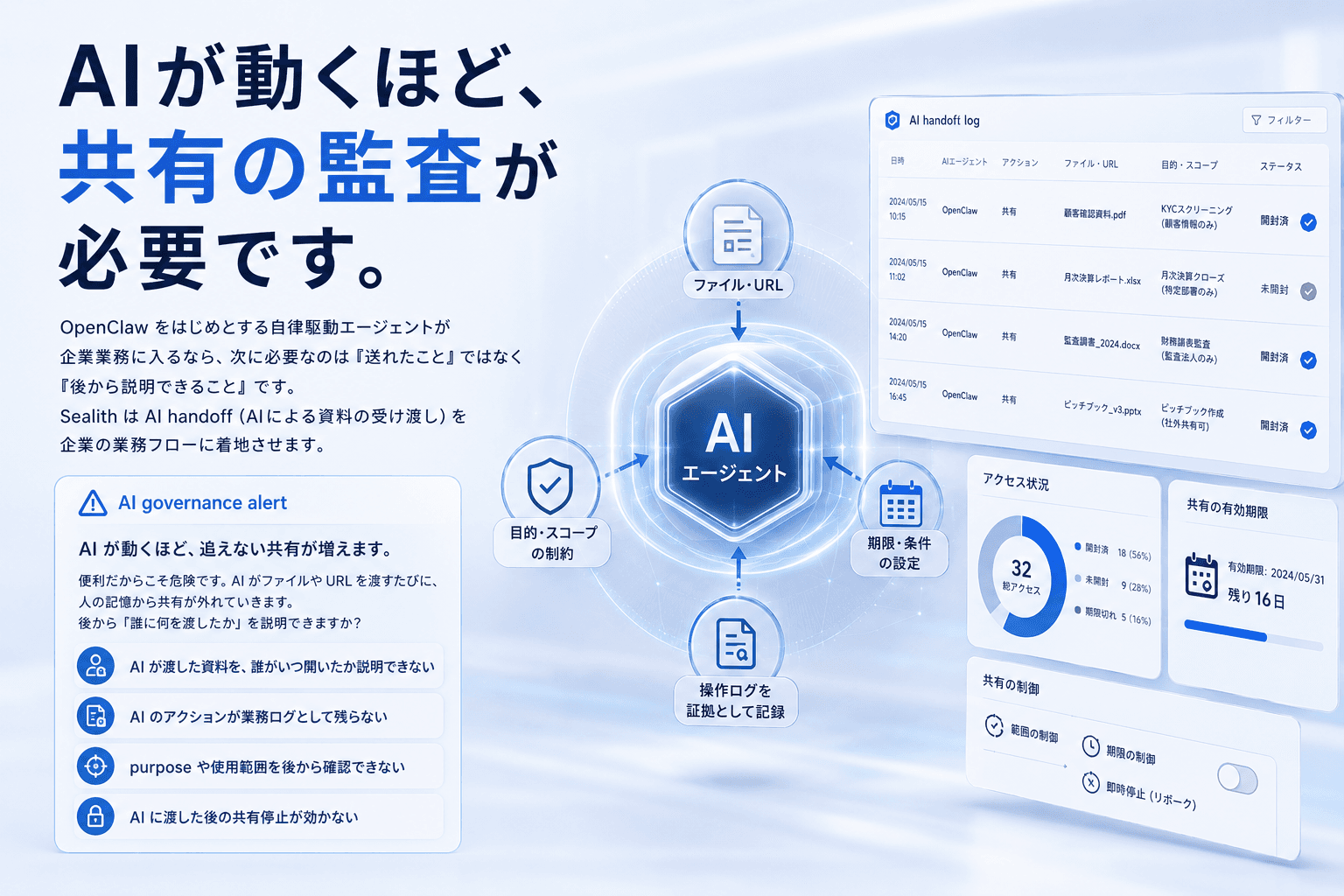
The more AI acts, the more untraceable sharing increases
Convenience is exactly why it becomes dangerous. Every time AI passes a file or URL, the sharing event slips further away from human memory. Can you still explain later who received what?
You cannot explain who opened materials after AI shared them.
AI actions do not remain as business logs.
Purpose and allowed usage scope cannot be reviewed later.
Revocation no longer works reliably once materials are handed to AI.
How it works
How OpenClaw and Sealith work together
Step 1
OpenClaw handles the materials
Autonomous agents such as OpenClaw work with files and shared URLs across sales, marketing, labor, accounting, and legal operations.
Step 2
Sealith fixes the handoff
Sealith turns who received what, for what purpose, and through which path into a secure handoff that can be audited later.
Step 3
Connect to real company actions
Review, reconcile, send, record, and revoke against the same evidence trail so AI activity does not break accountability.
Department playbooks
Operationalize AI handoff on both the growth side and the control side
Sales
AI organizes proposals, customer materials, and estimate URLs, then hands them off under fixed recipients, purpose, and expiry.
Marketing
Even if AI passes LP assets, report URLs, or partner materials outside the company, the delivery and open trail remains visible.
Labor
Candidate or employee documents are handed off only to the intended recipients, with clear scope and traceability.
Accounting
Even when AI processes invoices, statements, and evidence URLs, the record still shows who received what.
Legal
Contract review and DD material sharing remain traceable even in workflows where AI and humans are mixed together.
Why Sealith
Apply one audit standard to both people and AI
Different from ordinary storage sharing
Storage is good at holding files, but weak at proving who received what and why. It is not designed for AI handoff or purpose limits.
Different from ordinary transfer tools
Transfer tools can send, but they generally do not audit AI handoff, purpose, or tokenId-level evidence.
Where Sealith is stronger
Sealith lets people and AI share one audit ledger and track purpose, tokenId, and revoke through the same workflow.
Send
Register an encrypted file, secure text, or shared URL
Deliver
Separate the URL and passcode during handoff
Track
Record receipt, external-link visits, and AI actions
Stop
Stop receipt by expiry, count, or manual revoke
Playbooks
Standardize AI handoff through business playbooks
Playbook 1
Sales material handoff
OpenClaw packages proposals and shared URLs, hands them to the target company through Sealith, and tracks open, outbound click, and revoke.
Playbook 2
Contract review handoff
Send contract-review materials from OpenClaw through secure handoff, then pass them to internal AI while preserving purpose and tokenId.
Playbook 3
Evidence collection handoff
Bundle AI-generated request text, Sealith delivery, receipt checks, and resend into one accounting or labor workflow. Short credentials or notes that do not need a full file can be delivered as secure text.
Business fit
Make Business the main landing tier for AI handoff
Start with human sharing
For the stage where your team standardizes sharing rules with multiple admins, recipients, Cc/Bcc, scheduled sends, and browser draft recovery. Start by routing human sharing through Sealith first.
Business plan
For companies that need both AI adoption and explainability. Use API, MCP, Agent Token, and AI audit to hold people and AI to the same standard.
Overview
You may reuse this image in internal review or proposal documents.
AI Work Governance to Agent Commerce
Provenance for what AI creates. Approval for what AI releases. Recovery for what AI transacts
Even when an agent runtime such as OpenClaw performs the work, purpose, budget, price, fulfillment, and recovery for external transactions stay fixed at the Sealith boundary.
AI WORKSPACE / HARNESS
AI thinks and builds
Cloudflare OS, Gemini, Copilot, OpenClaw, or your own agent
AI WORK PASSPORT / RELEASE CONTROL
The company releases the work
Delegation, provenance signals, asset binding, policy, and human approval
SEALITH TRANSACTION BOUNDARY
The company delegates
Purpose, accountable entity, budget, quote, approval, and idempotency
PROVIDER / PAYMENT RAIL
The outside world fulfills
OnePlace, eSIM, JPYC, and future providers — reconciled through recovery
Start now
Turn AI handoff into an auditable operating workflow.
With OpenClaw integration, build a workflow where AI can act without breaking accountability. Start free and validate the core Sealith path first.